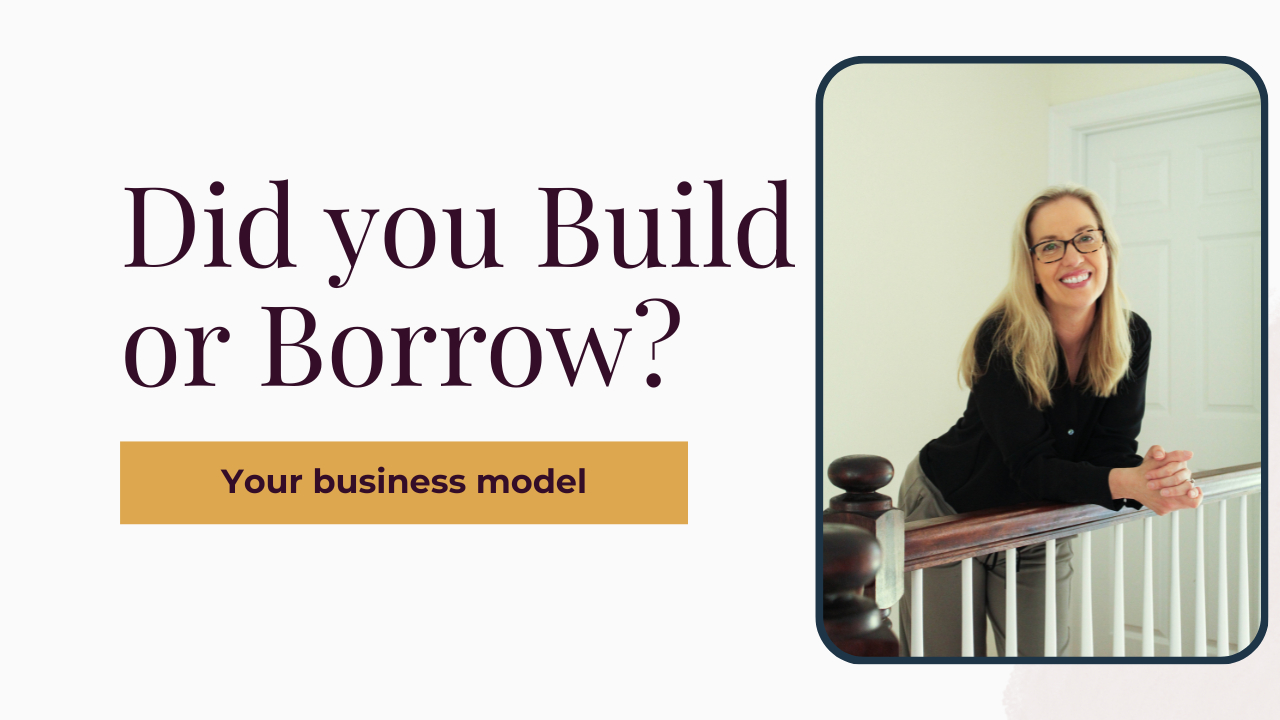
Did You Build a Business Model or Borrow One?
May 17, 2026
I'll be honest, when I started my private practice, I didn't even think about business models.
I found an office, paneled with insurance, and started building a caseload.
What I realize now is that I had adopted a business model...the insurance model.
And I don't say that as a criticism. At the time, it made complete sense. They handled the marketing and brought me clients. I was a new therapist who needed experience and a full caseload, and paneling with insurance companies gave me both. It was a genuinely useful arrangement.
But here's the thing I didn't fully understand then: when you adopt someone else's business model, you also adopt their terms. Their timelines. Their priorities. And when they decide to change the model (because they can) they're not going to run it by you first.
What is a business model, anyway?
Before we go further, it's worth naming what we're actually talking about, because "business model" can sound abstract or corporate in a way that feels disconnected from clinical work.
Simply put, your business model is how your practice generates revenue, who you serve, how you deliver your services, and what you charge for them. It's the structure underneath everything else.
Most of us in private practice have never explicitly designed one. We got licensed, we found a way to get clients in the door, and we kept going.
For a lot of us, that meant paneling with insurance companies, and thus the insurance model became our model by default, not by design.
When their business model didn't change but my skills and experience did
Here's what happened to me...and maybe you can relate. I spent years accumulating trauma trainings and certifications. Most years I didn't even check whether I met my licensure CE requirement because I had probably 2-3 times more than I needed.
I paid for high quality consultation monthly. My qualifications, skills and experience had expanded but my pay rates with the insurance companies did not.
That has never made sense to me. I have never worked in an industry where experience and training isn't compensated.
And it isn't the same for insurance reimbursements across all areas of healthcare. There is not one standard reimbursement rates for MDs. Can you imagine a Cardiologist with 20 years experience being reimbursed at the same rate as a new resident?
So at some point, most therapists who are highly skilled in a specific area, realize the disparity of the person licensed yesterday receiving the same reimbursement rate as they do.
This is one of the main flaws with the insurance model when it comes to therapists. Certifications and trainings are ignored and therefore the only way to make more money is to see more clients.
Because I was working with clients who had experienced complex forms of trauma, particularly in childhood, the original way I had structured my schedule (high volume) was leading to burn-out.
I needed to find a way to reduce the number of hours I work and make more money (to honor my experience and education).
And then life happened. I hit up against some personal challenges which required me to take more time off for self-care.
That was when I realized I had been operating inside a model I didn't build and couldn't control. And that realization was the beginning of something important.
The real risk isn't going off panel. It's having no flexibility.
When most trauma therapists think about leaving insurance panels, the fear that comes up is about clients. It feels like abandonment. Like we're choosing money over the people who need us.
I want to name that fear because it's real and it comes from a genuinely good place.
But I'd invite you to look at it from a different angle.
The question isn't really "insurance or no insurance."
The question is: are you operating within a business model you designed intentionally?
One with flexibility built in, so that when the landscape shifts --whether that's a personal shift (like I had) or the insurance company changes it's business model -- you have agency over what comes next.
Because here's what we don't know...how AI will impact our industry. But what I do know is that insurance companies are running a business, and they will make decisions based on what serves their business regardless of the impact on you.
If your practice is built entirely on their model, then when they adapt, your business is forced to adapt whether you chose that or not. You have no input. No leverage. No choice.
Agency is the goal, not a particular structure
I want to be clear: I'm not telling you to go off all insurance panels.
That decision depends on your caseload, your financial situation, your client population, and about a dozen other factors that are specific to you.
Some therapists build genuinely sustainable practices that include insurance. Others go fully private pay. Many find something in between by expanding their offerings.
What I am saying is that you need to be the one making that decision, based on a model you've actually thought through (not one you inherited by default and never examined.)
Ask yourself: if your top 2 insurance companies lowered their reimbursement rates tomorrow what would happen to your practice?
If the honest answer is "I don't know" or "I'd be in serious trouble," that's important information.
That's a reason to start thinking about what your business model actually is.
Building something that was mine
So what happened when I focused on my business model? Here's what that actually looked like.
I realized one way of of diversifying my practice was to provide consultation to other therapists. I became an EMDRIA Approved Consultant and started offering individual and group consultation.
I started to really contemplate my professional development and what I wanted to contribute to the field and that led me to co-teaching a 10 month webinar with a colleague.
I looked at the insurance companies I was paneled with and decided to go off one insurance panel. I didn't pick the lowest paying one, I picked the one that was causing me the most stress.
I realized hourly therapy wasn't allowing me to utilize EMDR in ways that really helped my clients make progress so I built an intensives business.
Eventually I went off my last insurance panels and became fully private pay.
And now my business is a combination of individual therapy, intensive therapy, individual and group consultation and providing consultation to trauma therapists for business development.
Here's the most important thing: it took time. I realized my business model wasn't working for me in 2020. It is now 2026.
The decisions to leave the insurance panels, I did slowly, intentionally and with plenty of notice to my clients.
Offering intensives was an entirely new business adventure as was developing Transform Your Trauma Therapy Practice. I already knew a lot about business but I learned so much more over these past 6 years.
Here's what I want you to take from this:
You deserve to have agency over your business model.
A sustainable practice model doesn't have to be complicated.
But it does take time.
It starts with a few honest questions:
Who do I want to serve?
How do I want to deliver care?
What am I passionate about?
What do I need to earn to do this work without burning out?
And what needs to change in my business?
Those questions are the beginning of a business model. They're also the beginning of having real agency over your practice, which is something most of us were never taught to claim.
This is exactly the work we do inside Transform Your Trauma Therapy Practice. The summer cohort is opening soon, and if this is landing for you, I'd love for you to be in the room.
Subscribe to the Email List
Subscribe for new posts and program updates.
I respect your inbox. Unsubscribe whenever you'd like.
