Launching a Business Program for Trauma Therapists
May 26, 2026Last year, I did something I never thought I would do. I launched a business program for trauma therapists.
It wasn't planned. It wasn't part of some grand entrepreneurial vision. It started when I hit a wall in my practice and I had to make changes. I needed to make more money and work fewer hours so I began developing an intensives business.
And as my practice was evolving, my colleague Laura asked for my help in making changes to her business. She's the one who said, "You need to put together a program. We [trauma therapists] need this and we need help from another trauma therapist who understands the reasons why we do this work."
Like Laura, most of you found me through the clinical work. The webinars on EMDR and Structural Dissociation or through consultation where we wrestle with the tough questions: how to work with dissociation, how to navigate complex transference and countertransference dynamics, how to support clients in healing deep relational wounds from childhood.
But in between the clinical questions, I kept hearing something else. The exhaustion in your voices when you talked about your schedules. The frustration when you mentioned caseloads or insurance reimbursement problems. The way you'd casually mention working evenings and weekends to keep up with notes, like it was just part of the job.
What I realized about our field
Here's what became clear to me. Trauma therapists are incredibly dedicated to their work. They're committed to expanding their knowledge, to their clients' growth and healing. The work changes people. It changes the trajectories of families. It's some of the most critical work being done in healthcare today.
And most trauma therapists are busy accumulating trainings on how to be better trauma therapists. EMDR, IFS, somatic work, complex trauma, dissociation. Tens of thousands of dollars in specialized clinical education.
But their businesses have been neglected, not because they don't care about sustainability, but because nobody ever taught them how to run a practice designed around the emotional and clinical complexity of this work.
My colleague Laura realized I had something unique to offer. I'd spent years in corporate leadership before becoming a therapist. I ran a small business for several years while in grad school. And I've been a trauma therapist for 12 years now. I understood the business side of this equation in a way that most people don't.
Generic business coaching doesn't work for trauma therapists. When someone tells you to "just charge your worth" or "set better boundaries," they're not thinking about the transference dynamics that show up around money. They're not considering how carrying trauma stories affects your decision-making capacity. They don't understand why it's harder for us to implement standard business strategies.
Why I built Transform Your Trauma Therapy Practice
I launched the first cohort in June 2025. Then a second cohort in February 2026. Over the last year, I've also created a business foundations video course (which I hope to receive NBCC CE credits this year...application pending) and a website copywriting tool specifically for trauma therapists.
Transform Your Trauma Therapy Practice is an 8-week group coaching program designed to help trauma therapists claim their business owner identity.
We cover how to ethically establish rates that reflect the years of training you've accumulated. How to identify your therapeutic superpowers and communicate them clearly. How to make your business more sustainable by tweaking your current model or expanding with new offerings.
The program includes a full digital course, a website copywriting tool, 16 hours of coaching calls over the 8 weeks, plus direct access to me via Voxer between calls. But the most important part isn't me or my knowledge. It's the support of a community of like-minded therapists growing together in real time, supporting each other through the process.
At the end of the 8 week program, graduates have the opportunity to join a monthly community where we focus on our businesses together. Because this work is ongoing. Building a sustainable practice isn't a one-time project.
Why this matters now
The ground is shifting beneath trauma therapists right now, and most of us can feel it. AI is changing everything and how it will impact our field we can't possibly predict. Insurance companies are experimenting with AI-assisted therapy. Clients are using ChatGPT to process between sessions.
None of that is going away, which means we need to understand our businesses well enough to adapt when we need to. We need to know how to flex and adjust our models as the landscape changes.
But there's something bigger happening too. The current environment is draining the empathy reserves we need to do this work before we even sit down with our first client. The need to develop practices that sustain us has never been greater. That's what this program is built for: not just sustainability in a stable landscape, but the capacity to adapt as the landscape shifts.
This isn't about becoming wealthy or only serving people who can afford to pay high fees. It's about building practices that honor our expertise and sustain our energy. It's about making sure trauma therapists can continue doing the work that matters most, without burning out in the process.
What I've learned from two cohorts
The transformation I've watched in these therapists has been remarkable. Not just in their practices, but in how they see themselves.
They start the program feeling overwhelmed by the business side. By week eight, they're making confident decisions about their rates, their policies, their ideal clients. They're thinking strategically about their practices in ways they never had before.
Some have dropped their lowest-paying insurance panels. Others are making plans to be fully private pay. Some have added group programs or intensives. Some have raised their rates by $20 and restructured their schedules. The right outcome is different for everyone, and that's exactly how it should be.
What's consistent is this: they leave feeling like they actually know how to run their business. They start making decisions from intention instead of default. They claim the identity of business owner alongside therapist, and they discover those two roles strengthen each other rather than compete.
What you need to know
I've taken my years in corporate, small business management, and trauma therapy and distilled it down to what you actually need to know to run your practice. I've kept the focus on what's actually practical, because I know your real motivation is getting back to the work you love with your clients.
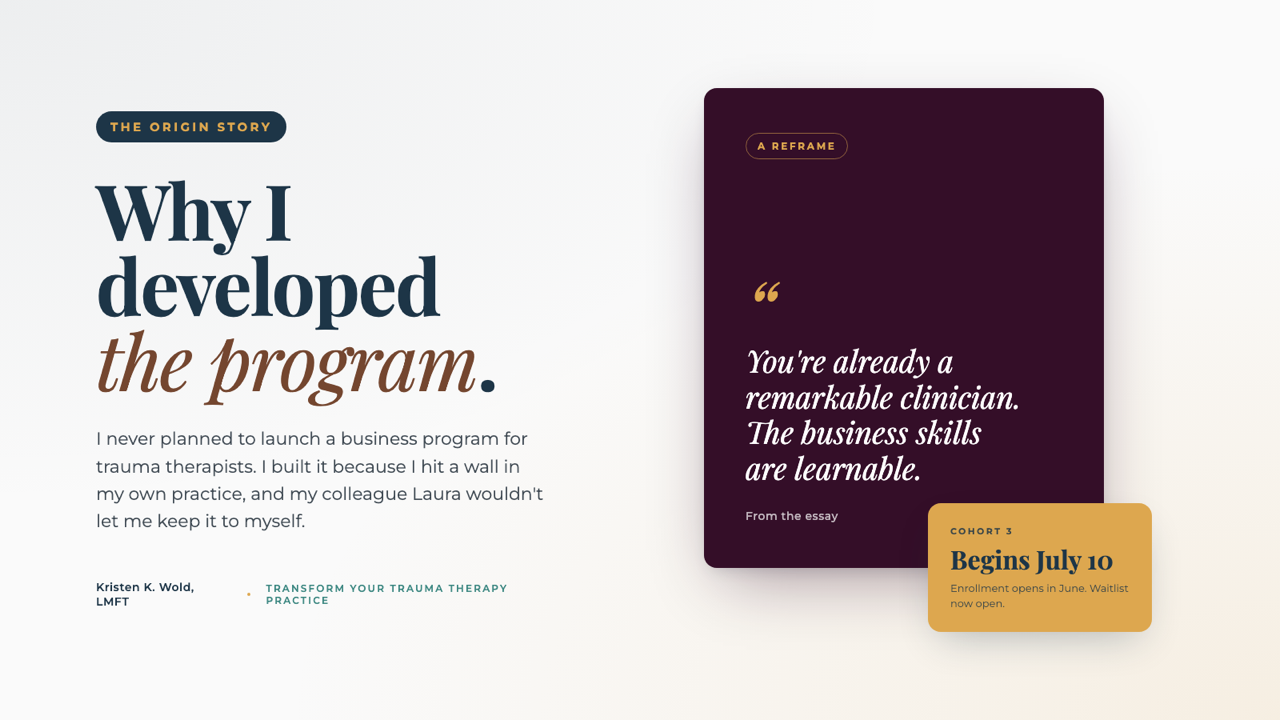
The third cohort begins July 10th. Enrollment opens in June. I'd love to have you join us if you are ready.
But here's what I want you to understand, whether or not you ever join my program: the training you've accumulated to become competent in trauma work is far harder to acquire than any business skill you'll ever need to learn.
If you can learn to work with someone who has experienced complex childhood trauma, you can absolutely learn to set sustainable rates and write website copy that attracts your ideal clients.
The neglect of the business side isn't a character flaw. It's a predictable outcome of a training culture that emphasizes clinical skill and says almost nothing about how to run a sustainable practice.
You're already a remarkable clinician. The business skills are learnable. And you deserve a practice that reflects the depth and importance of your work.
The profession needs you. Not burned out and resentful, but energized and sustainable. Because when trauma therapists thrive, the ripple effects extend far beyond any individual practice. They reach into families and communities and impact generations.
That's why I built this program. That's why I'm proud of it. And that's why, if you're ready to think differently about your practice, consider joining us.
Subscribe to the Email List
Subscribe for new posts and program updates.
I respect your inbox. Unsubscribe whenever you'd like.
