
What the ACCESS Model means for therapists in private practice
Nov 06, 2026There's a battle happening in our industry. State legislatures are trying to put guardrails around AI-delivered "therapy." The federal government, through CMS, is advocating for a layer of technology-delivered care for chronic health conditions, including depression and anxiety, via the ACCESS Model.
As of November 4, 2026, seven states have enacted laws specifically restricting AI-delivered therapy or the marketing of AI as a therapist: Illinois, Nevada, Colorado, Maine, Rhode Island, Tennessee, and Vermont. Other states have implemented disclosure, privacy, and crisis-response protections for mental-health or companion chatbots rather than restricting therapy itself. For more information, see the reference list.
What does this mean for therapists in private practice?
First, a clarification, because I've heard this in response to my previous posts: I'm not debating the benefits of outcome-based treatment. I'm looking at what this means for your business if you are in private practice, and it's through the business lens that I offer my perspectives.
How the fee-for-service therapy model is changing
What is happening now is a shift in the business model of how mental health care is delivered.
The traditional business model that we have been operating within is the fee-for-service model. Individuals seeking support for mental health symptoms expect help will come in the form of finding and meeting with a therapist, one-on-one.
For the insurance company, reimbursement of these sessions is an expense. And we all know what corporations need to do with expenses...reduce them.
And since the passage of the Mental Health Parity and Addiction Equity Act in 2008, insurers have been limited in their ability to reduce fee-for-service expenses.
In 2008, Congress passed the Mental Health Parity and Addiction Equity Act, limiting insurers' ability to impose more restrictive requirements on mental health care than on comparable medical and surgical care, including standards for providers to join their networks. The Affordable Care Act, passed in 2010, added network adequacy requirements for Marketplace plans, requiring sufficient providers to make covered care available without unreasonable delays. Together, these protections constrained how plans subject to the rules could restrict access to in-network mental health care.
ACCESS gives insurers a different lever. It isn't a cheaper therapy session. It's a different kind of care altogether.
CMS's new ACCESS Model moves away from fee-for-service for some chronic health conditions, including depression and anxiety. It pays based on outcomes, delivered through technology-enabled solutions.
What is the ACCESS Model?
ACCESS stands for Advancing Chronic Care with Effective, Scalable Solutions. It is a voluntary, national, 10-year model for Original Medicare that tests whether outcome-aligned payments can improve care and reduce costs. It began in July 2026.
The ACCESS Model in Medicare is a new CMS payment test that rewards organizations for outcomes rather than the number of visits or services delivered, and it includes a behavioral health track for depression and anxiety.
How does the ACCESS Model work for a client?
A potential client is in need of behavioral health services. Maybe they are referred by their PCP or look for options through their insurance company. They are then referred to a platform.
On the platform, they complete the assessments, PHQ-9 and GAD-7, and if they meet criteria, they are referred to a company that is participating in the ACCESS Model.
The company will offer its technology-enabled solution to the client over a 12-month care period. The company receives recurring payments during that year, but full payment depends on outcomes: in the first year, at least half of its clients have to meet their improvement targets. If fewer do, the company's payment is reduced.
If a client is enrolled with an ACCESS organization, that organization can't bill insurance separately for weekly sessions. Any therapy it adds comes out of its ACCESS payment.
CMS says this is a way to allow more clients access to treatment.
And most of the major commercial insurers have signed the ACCESS Payer Pledge to align with the model by January 1, 2028.
What the ACCESS Model could mean for private practice referrals
This is my hypothesis as to what we will see unfold over the next year or so.
We have been watching as tech firms continue to move into the therapy space, consolidating credentialing, payment processing, and EHR functions, and building large funnels that potential clients move through. See my post on why your insurance referrals are drying up.
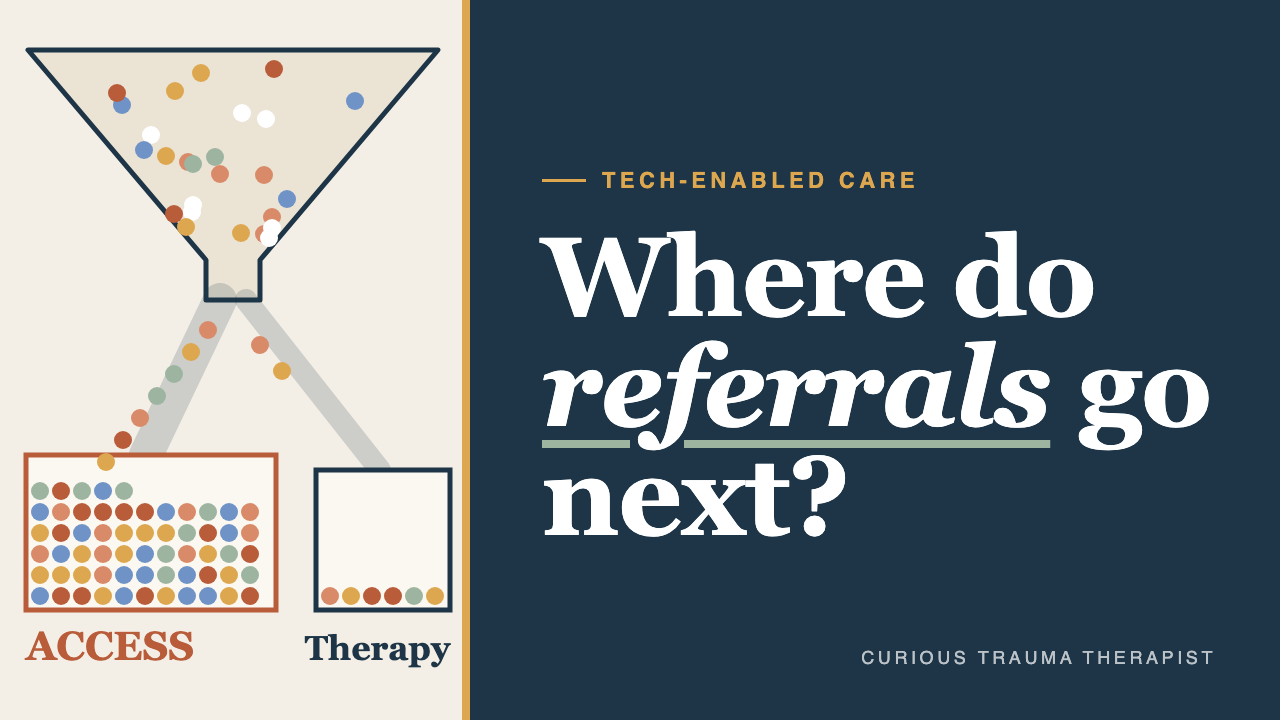
Historically, the clients who came into the funnel would be matched with a therapist for outpatient therapy.
Now the funnel will have two paths. The first path, for people who meet ACCESS criteria, leads to the technology solution. The second leads to outpatient therapy.
To be fair, what CMS is saying is that there are far more people needing therapy, so when they offer the technology solution, they are providing more people with access to treatment.
So maybe that won't change the number of clients referred to therapists.
But here's what we know: CMS and insurance companies are trying to reduce costs associated with healthcare.
A 45-minute 90834 session is reimbursed at roughly $85 (an estimate, since rates vary by state and license type). A year of weekly sessions costs an insurer over $4,000. The most ACCESS pays per client for a full year is $180.
If they say their motivation is to increase access to care while reducing costs, it's easy to hypothesize that they will move as many people to the ACCESS Model as possible.
Because this is still rolling out, the impact on your private practice is not known yet. We know the rules CMS set for Medicare, but we don't know how commercial insurers will choose to implement them.
But what we have seen is that when insurers have consolidated clinicians on platforms, independently paneled clinicians have noted a slowdown in referrals.
If more people who qualify for depression and anxiety treatment are funneled into a technology solution that costs the insurer much less, a good guess is that private practice referrals will slow even more.
CMS says ACCESS is "designed to complement traditional care." It's hard not to imagine it becoming the first layer instead: a technology solution as the standard first line of care for people who struggle with anxiety and depression, with costly individual sessions reserved for people who don't improve with the technology.
What should you do if you are a therapist in private practice?
My advice is to take charge of your business. For decades, we have taken advantage of the referral pipeline from insurance companies to fill our caseloads. When I opened my private practice over a decade ago, starting it did not require extensive business knowledge.
But now things are shifting and it's time to look at your practice as a small business. You own a small business and are going to be responsible for all aspects of it, including where your income comes from and marketing your services.
Here are some concrete steps I would take:
- Diversify your caseload. If your entire caseload is on one platform or insurance panel, start thinking of ways to be less financially reliant on it. If 90% of your caseload is on Alma and they change the rules, it's very hard to pivot your business quickly. If they are 20% of your caseload, leaving the platform will have less of an impact on your income.
- Develop a website (even if it's a one-pager). Potential clients need to have a way to contact you directly. If you have a website that you haven't looked at in years, dust it off and start updating it one page at a time.
- Look at the options for your business income. You can transition to private pay, add supervision or consultation, provide education and training, or build other income streams. It's not impossible to expand your income. It just takes time.
The industry will be shifting dramatically over the next year or so. Take the time now to invest in trainings to help you understand your business and make intentional business decisions.
I run a program to support trauma therapists in understanding their businesses. And on November 19, I'm hosting a free industry update on what we know about the ACCESS Model and technology-enabled care. I'll be taking questions and sharing what I know. You can register here.
References
- Baker Botts, New state laws regulating AI use for mental healthcare (October 14, 2026)
- CMS, ACCESS Model
- CMS, Major health plans join the ACCESS Payer Pledge
- Robert Longyear, The ACCESS Model's behavioral health track
Subscribe to the Email List
Subscribe for new posts and program updates.
I respect your inbox. Unsubscribe whenever you'd like.
